
Devara: Part 1
Devara: Part 1 is a Telugu action drama on gomovies with high-octane, which is written and directed by Koratala Siva, with N.T. Rama Rao Jr. (Jr. NTR) playing a fierce avatar in the dual role. The movie is one of the most expected pan-India releases in 2024, which will bring together the audiences of all languages and regions. This epic saga was produced by Sudhakar Mikkilineni and Kosaraju Harikrishna under the Yuvasudha Arts and NTR Arts, and the setting of the epic saga is on the wild coasts of India. This story is based upon the themes of power, revenge and heritage-the way the decision of a single man influences the fate of a whole clan. Full of visuals, emotional richness, and thunderous acting, Devara: Part 1 emerges as a movie to be recalled.
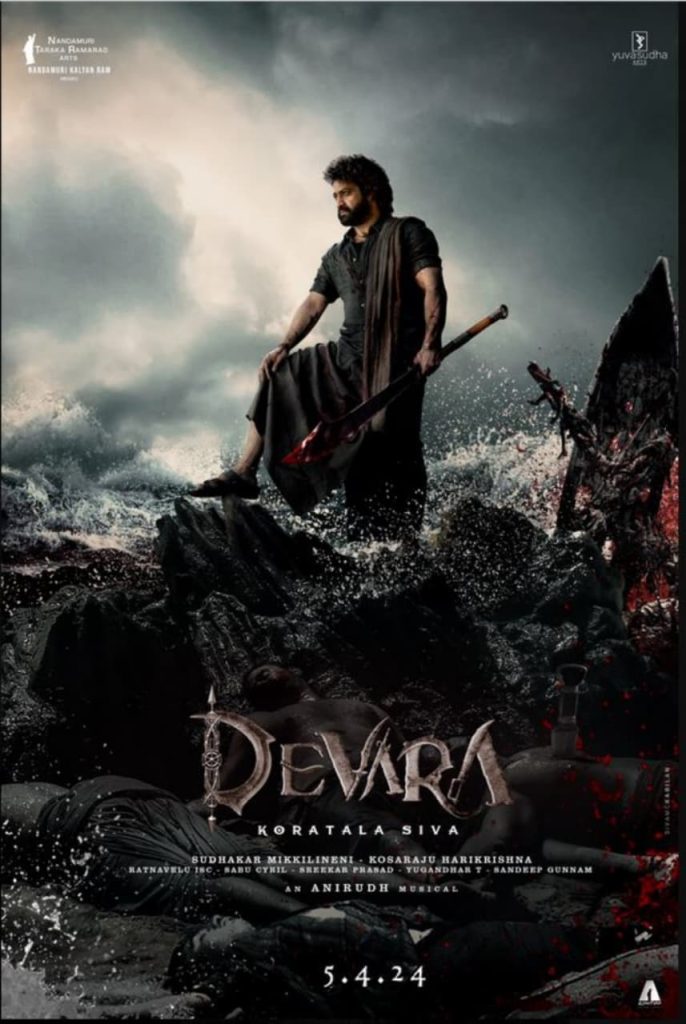
As early as the opening frame, the movie puts the viewer in a sea of the storm, blood-covered honor, and ethical anarchy. Koratala Siva, with his socially laden storytelling, enters the darker and more mythical realm here. Devara is a mix of unfiltered emotion and big-screen action, examining the way justice is triumphed over by a betrayal. The imagery, sound design and narration are combined into a sweeping movie experience. Devara: Part 1 is not just a glorification of NTR on the screen, but it also establishes a universe full of lore and legacy.
| Aspect | Details |
|---|---|
| Title | Devara: Part 1 |
| Director | Koratala Siva |
| Producers | Kosaraju Harikrishna, Sudhakar Mikkilineni |
| Production Houses | Yuvasudha Arts, NTR Arts |
| Starring | N.T. Rama Rao Jr., Janhvi Kapoor, Saif Ali Khan, Prakash Raj, Shine Tom Chacko |
| Cinematography | R. Rathnavelu |
| Music Director | Anirudh Ravichander |
| Editor | A. Sreekar Prasad |
| Genre | Action, Thriller, Drama |
| Release Date | October 10, 2024 |
| Languages | Telugu, Hindi, Tamil, Malayalam, Kannada |
Plot
Devara: Part 1 is a fiction set on the rough eastern coast in India and explores the theme of crime, revenge and justice. The movie narrates about Devara (Jr. NTR) who was a coast guard who is feared by his adversaries and is adored by his subjects. Devara has to struggle to protect not only his clan but his son as well when his legacy is endangered by treachery and bloodshed. When the secrets of the past start tearing apart a war between vengeance and redemption breaks out. The novel deals with the question of the boundary between the protector and the destroyer–the cause of righteousness becomes violent.
The two faces of Devara are introduced in the second act, one is the face of rage, the other one is the face of redemption. The narrative structure of the film is complex and demonstrates the intergenerational struggle by the fact that the sins of fathers resonate in sons. The tension is of epic scope with Saif Ali Khan as the merciless villain Bhaira. The moral tide is turning as the waves crash on the shore and the hero is put to the test of his faith and humanity. Love, loss, and legacy are the emotional support of the story, the foundations of its spectacle, which is of the size of a planet, but which is supported by the depth of the heart.
Performance
Jr. NTR plays a giant role that characterizes Devara: Part 1. His two-sidedness, ferocious and restraining, is exciting and emotionally vibrant. It is so intense that whether he is a warrior, a father or a fallen savior, his presence dominates every frame. His speech delivery is powerful, his words are full of pain and strength, and his physical change is spectacular. It is a character that reinvents his flexibility and his emotional richness.
Saif Ali Khan appears as a villain, Bhaira, who is greedy, ego-filled, and has old scores to settle. His image brings in a sense of danger and refinement, and serves as an ideal antithesis to the moral flame of NTR. Janhvi Kapoor, in her Telugu debut as Thangam, infuses grace and sensitivity to her part, striking a balance of the roughness of the movie with gentleness. Prakash Raj and Shine Tom Chacko support the story with its authenticity and gravitas. Each performer plays his or her role in the great tapestry of this emotional and violent adventure.
Direction and Screenplay
Director Koratala Siva reinvented himself with Devara: Part 1, but this time by avoiding social realism and shifting to epic mythic narrations. His style is more dark, more physical, and more morally gray, where loyalty is a virtue and a curse. The screenplay is a storm, unpredictable, fierce, and inexorable, and it takes the chaos of war on the coast and emotional standoff. Acts are rhythmic with a climax scene at the end leaving the audiences shocked and anticipating Part 2. Siva creates a space that is simultaneously ancient and modern and myth-grounded in realism.
The screenplay is acute and emotionally involved, combining several timelines and points of view without a sense of confusion. All conversations are symbolic, with a touch of revenge and legacy. The pacing is a balance between slow-building tension and explosive action, and both character and spectacle have the opportunity to shine. Although the basis of the story is revenge, the way in which the story achieves this revokes human morality and power cost. It is a movie that is narrated passionately and furiously with poetry.
Music
The music of Devara composed by Anirudh Ravichander is a musical powerhouse; it is dark, spiritual and thundering. His background score is the heartbeat of the movie adding action and emotion with the precise intensity. The melodies are a mixture of folk beats and contemporary orchestration and reflect the uninhibited nature of the coastal environment. Such songs as Fear Song and All Hail the Tiger were an immediate hit in the charts and made the movie a cultural phenomenon even prior to its release. The song moves the rhythm of all the action sequences and emotional chords.
What is more impressive is that Anirudh employs silence just as strongly as sound. When the tension occurs, the lack of music increases the tension, and the viewer can experience the burden of all decisions and deaths. The score is reflective of the duality of the character Devara who is both divine and destructive. Old devices such as conch shells and drums are combined with electronic bass to make a tribal but space age sound environment. It is an album that rattles theatres and moves hearts.
Theme
On the most fundamental level, Devara: Part 1 is a tale of heritage, redemption, and the brutality of justice. It raises the question of whether vengeance can ever bring peace or it just creates more blood. The sea itself is turned into a living symbol – it symbolizes anger, a new beginning and the inescapability of fate. The conflict that Devara goes through is the one that has existed and will always exist between duty and desire. His experience demonstrates that even the guardians may be transformed into the murderers once the truth is turned into a betrayal.
There is also the theme of fatherhood and inheritance in the film, as the new generation has to carry the weight of the decisions made in the past. Devara explores the corruption of authority and the innocence of death through its stratified narration. It is a personal tragedy and a mythical parable on fate. Duality is a theme that permeates the film, light and dark, justice and revenge, life and death, and is all present in the soul of Devara. It is finally a movie reflecting on power, loss and immortality.
Cinematography and Technical Excellence
The cinematography used by R. Rathnavelu turns Devara into a picture epic. Each frame is an alive one–with the shriek of the sea, with the gleam of blood, with the shimmer of faith. The palette of greys, blues and gold which are coastal makes the film mythic and timeless. The expansive landscapes are filmed with wide shots and the emotions of human feeling can be seen through the close-ups. Action sequences are shot with accuracy and fluidity and it lacks overboard realism and includes cinematic beauty.
The rhythm is made by the editor Sreekar Prasad to ensure the tension is taut and the emotions are sharp. The visual effects are used to augment the story, and not to overwhelm it, marrying practical stunts with CGI to create a perfect fit. Aneeha Naidu costume design is an indication of the coastal culture of warriors- gritty, rough, and meaningless. All the technical aspects, such as lighting, production design, etc., help create the world of the film. Devara: Part 1 is a tribute to the Indian craftsmanship and visual narration of high quality.
Conclusion
Devara: Part 1 (2024) is not a film, it is a storm in the cinema. Explosive performance of Jr. NTR, the visionary direction of Koratala Siva, the electrifying score of Anirudh makes the film redefine what the Indian action drama can do. It is emotional, violent, poetic and exaggerated. Each scene is full of intention, each frame narrates a tale of suffering and strength. It leaves the viewers shaken and spell bound.
Although the story ends on a cliffhanger, it is the ideal background to Devara: Part 2. The initial one manages to do the world-building and emotional foundation so that the subsequent sequel will be even more weighty. Its combination of myth, morality and contemporary movie size renders it a must watch movie to all the action and drama enthusiasts. Devara: Part 1 is not only a frenzied movie but also a movie of fury, redemption, and a vile cycle of fate. It is currently available on GoMovies to enjoy a memorable movie experience.