
Interstellar
Interstellar is one of the most incredible sci-fi dramas on gomovies of Christopher Nolan that combines science, philosophy, and emotion in a single breath-taking story. It is the story of love, time, and survival of humanity that stars Matthew McConaughey, Anne Hathaway, Jessica Chastain, and Michael Caine. The film takes place in a future Earth, just before the imminent ecological catastrophe, as a team of astronauts embark on a trip to locate a new livable planet beyond the stars. Nolan presents human limits of strength and the power of bonding across galaxies through space and time. Every scene of the movie is a visual marvel and a heartfelt experience, thus Interstellar is an incredible movie experience that one will never forget.
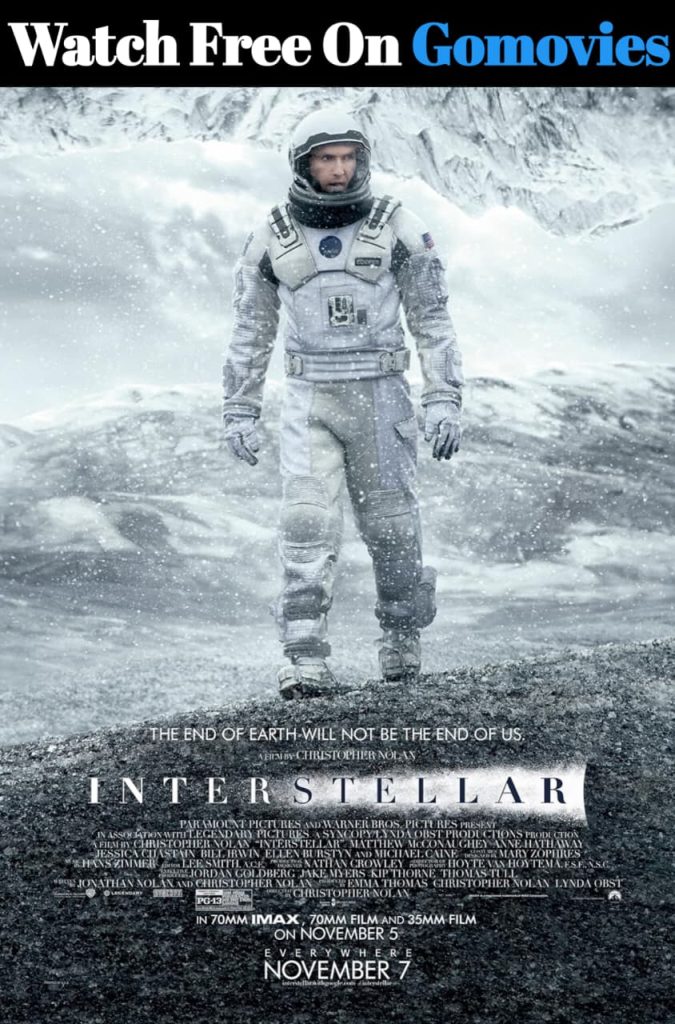
The movie has successfully integrated both hard science and storytelling. Through actual theories of relativity and the black holes Nolan bases his epic adventure on credible science and at the same time, retains emotional closeness. The film has its emotional focus in the performance of McConaughey who is separated with his daughter. The film flows perfectly between large-scale cosmic images and very intimate scenes of desire and hope. Interstellar is not a science fiction movie, but a touching story of what it is like to love, lose, and have faith.
| Aspect | Details |
|---|---|
| Title | Interstellar |
| Director | Christopher Nolan |
| Producer | Emma Thomas, Christopher Nolan, Lynda Obst |
| Production House | Lynda Obst Productions, Syncopy |
| Starring | Matthew McConaughey, Anne Hathaway, Jessica Chastain, Michael Caine, Matt Damon |
| Cinematographer | Hoyte van Hoytema |
| Music Director | Hans Zimmer |
| Editor | Lee Smith |
| Genre | Science fiction, drama, adventure |
| Release Date | November 7, 2014 |
| Runtime | 169 minutes |
| Languages | English, Hindi (dubbed) |
Plot
Interstellar starts on a planet in its death, with food ration and dust storms looming on the existence of humankind. Courtesy of his daughter Murph, who feels that their house is haunted by strange signals, former pilot Cooper (McConaughey) leads a peaceful life as a farmer. These clues later guide them to NASA which is covertly preparing a voyage to discover a new home to mankind. Cooper accepts to take part in the mission, abandoning his family and riding a wormhole around Saturn. This is followed by a journey through the whole universe, and even through time itself.
The crew is exposed to the spectacular and the horrible as they venture to different worlds. The time dilation, gravity and loss start to become the main themes as Cooper tries to cope with his responsibility to save the humankind and his desire to come back to Murph. Both planets are the embodiment of hope and danger, and the limits of human bravery and strength. The emotional essence of the movie is intensified by the fact that Murph is growing up on the Earth and she still hopes that her father will come back. The love between them is the barrier that helps to unite two worlds that are separated by time and space.
Performance
Cooper is one of the strongest roles played by Matthew McConaughey. His description reflects the adventurous spirit of a pilot as well as the frailty of a loving father. His emotional sincerity in each scene bases the great scientific ideas behind the movie in human emotion. The farewell scene with his daughter and his subsequent breakdown watching years of video messages is a milestone of the cinema. McConaughey convinces viewers in the unrealistic science and the higher power of love.
Anne Hathaway is a brilliant Dr. Amelia Brand, who is both brilliant and compassionate. The philosophy of her character that love is some power that breaks time and space becomes one of the philosophies of the movie. Jessica Chastain also infuses fire and intelligence into adult Murph and she brings pain, brilliance and hope to her with equal strength. Michael Caine as Professor Brand imbues the mission with the emotional dimension. The ensemble makes Interstellar a work of the most human and touching nature.
Direction and Screenplay
Christopher Nolan once again demonstrates that he is a genius of the combination of the mind and the heart. His direction is a balance between the cosmic wonder and a personal story of a father and a daughter who are separated by light-years. Each scene, be it located on an alien world or in a spaceship, is designed with painstaking accuracy. Nolan employs actual physics to narrate a tale of metaphysics, without any sense of division between science and spirituality. He has mastered pacing, which is why the audience is held even during silent moments of reflection.
Co-written by Nolan and his brother Jonathan Nolan, the screenplay is based on the theme of sacrifice, destiny and human perseverance. Dialogue is not random, but frequently philosophical, as well as emotionally intense. The structure of the story reflects the intricacy of time itself, and the nonlinear moments are intertwined into a single story. Relativity as a storytelling device makes it tense and poetic at the same time. Every scene is leading to a mind-twisting and emotionally fulfilling ending.
Music
The score written by Hans Zimmer in the movie, Interstellar is a masterpiece of its own, as it turns the movie into a spiritual experience. With the help of church organs, haunting choirs, and deep ambient tones, Zimmer creates an endless and yet personal soundscape. The music does not merely follow the images, but it drives them, the music itself reflects the distance of space and the profundity of feeling. The score of his docking scene is one of the most exciting and memorable scenes in cinematography. All the notes appear to beat in sync with the beat of the universe.
The compositions of Zimmer dwell on silence as much as the sound, which adds tension and greatness to the film. He employs the technique of minimalism and transforms emptiness into emotional force. Every song shows the science and soul duality that characterizes Interstellar. What is achieved is a score that goes beyond the screen and forms a crucial element of the identity of the story. The music by Zimmer remains in the minds of the audience even after the last credits, and it resonates with the message of the film concerning the perennial nature of love.
Theme
The film Interstellar is fundamentally a story about the strength of love and the strength of the human spirit. It contends that despite the cosmic triviality, emotion is still our strongest point. The movie changes the science into emotional reality, and love, it is possible that love can be as real as gravity. The time, distance and sacrifice all test the faith that the characters have in this invisible connection. Ultimately, it is love that brings Cooper home and not science in itself.
The relationship between man and the universe and the survival instincts of humanity are also covered in the movie. It raises a question of whether our planet is worth the soul of progress. The image of the disintegration of the Earth echoes contemporary worries regarding climate change and ecological disaster. But Nolan gives us hope–that the curiosity and the pity of mankind can survive even extinction. Interstellar ends up being a love story to both science and the infinite pursuit of meaning by humanity.
Cinematography and Visuals
Cinematography by Hoyte van Hoytema is such a work of precision in the infinite and the intimate that it is unbelievable. The IMAX images allow the audience to be swept by the spectacular grandeur of the space and maintain the emphasis on human feeling. Every frame is carefully made, whether it is on the dusty plains of Earth or the frozen terrain of the far-off planets. The Wormhole and the sequences of the black hole were enacted using real astrophysical equations and this is what renders realism in science fiction cinema. What has been created is an awe-inspiring and authentic experience.
The visual effects of the film, which are supervised by Paul Franklin, blend perfectly with real photography and practical sets. Believability was achieved by using miniatures and real models without giving the false appearance of a typical CGI. All the components, including the rotating Endurance spacecraft or the tidal waves of the Planet of Miller, are realistic. The dedication to realistic craftsmanship makes Interstellar have an eternal look. It is an aesthetic experience that breaks the line between science and art.
Conclusion
Interstellar is a film that can be described as one of the most ambitious and emotionally resonant movies ever. It is a rare combination of scientific precision and emotional narration that transcends the stars to reach the heart. Christopher Nolan demonstrates that science fiction can be thought-provoking and deeply human at the same time. The emotional climax of the movie, when the father and daughter meet each other with a time gap, is one of the most emotional ones in cinema. It is not only space but it is also connection, sacrifice and hope.
Interstellar is a must watch film to those who want to have their mind and heart stimulated. All the elements, acting, direction, music, and visuals, are in perfect harmony with each other. It makes us remember that technology is not the most powerful tool of humanity, but empathy and love. Interstellar is not just a film, it is a commentary on what it is to be a human being. Now play it on GoMovies, and in your imagination travel over the stars and to the very core of time itself.