
Tenet
Tenet is a provocative and head-bending science fiction action thriller on gomovies authored and directed by Christopher Nolan. Nolan is known to push the boundaries of film narration to the limit and creates a complex world in which time itself is a weapon and a mystery. The movie is directed by John David Washington, Robert Pattinson, Elizabeth Debicki, and Kenneth Branagh, and it revolves around the notion of time inversion, when the cause and effect may be exchanged. The story reads like a puzzle, and one has to pay attention, but at the end of the puzzle, each piece is paid off as the picture becomes complete. Tenet is not merely a film, it is an experience that messes with your sense of time and narrative.
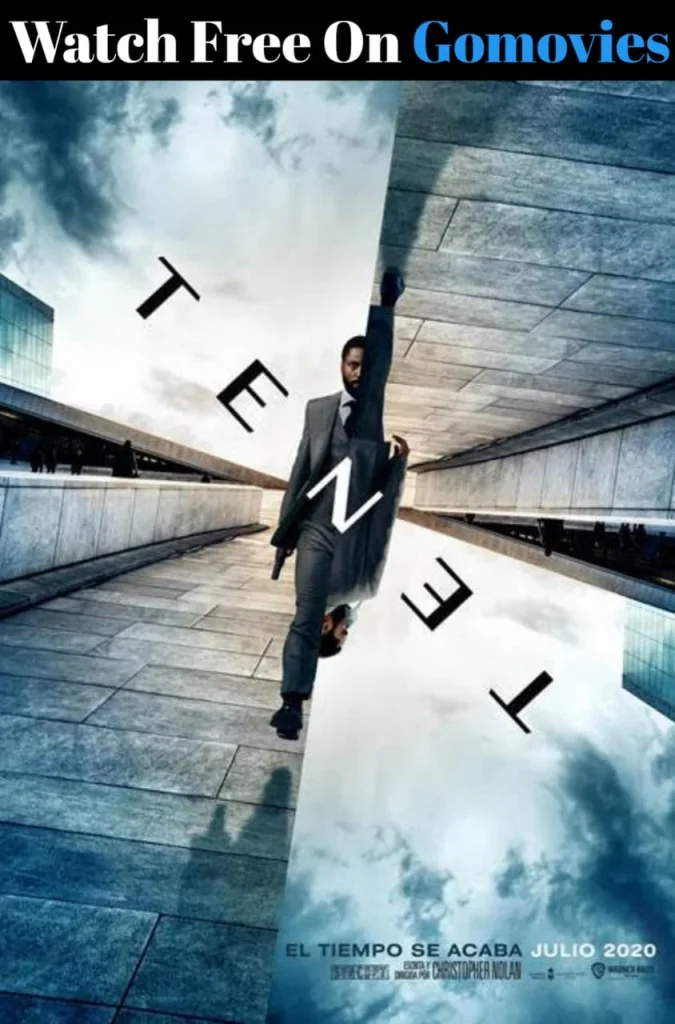
Each frame of Tenet is overwhelmed with precision that Nolan is known to love, a combination of spectacle, science and suspense. It is an espionage thriller in its core, but with quantum concepts that restructure conventional action filmmaking. The director expertly combines physical tricks and philosophical insight, building the world where reason intersects with feelings. Behind the complication is a tale of devotion, sacrifice and the human endeavor that is opposed to fate. Like all Nolan works, the movie compensates people who are willing to think outside the box.
| Aspect | Details |
|---|---|
| Title | Tenet |
| Director | Christopher Nolan |
| Producer | Emma Thomas, Christopher Nolan |
| Production House | Warner Bros. Pictures, Syncopy |
| Starring | Robert Pattinson, John David Washington, Elizabeth Debicki, Kenneth Branagh, Dimple Kapadia |
| Cinematographer | Hoyte van Hoytema |
| Music Director | Ludwig Göransson |
| Editor | Jennifer Lame |
| Genre | Action, Thriller, Science Fiction |
| Release Date | August 26, 2020 |
| Runtime | 150 minutes |
| Languages | English, Hindi (dubbed) |
Plot
The movie stars an unnamed Protagonist (John David Washington), an CIA agent who is sucked into a mysterious realm following a close death mission. He finds out the idea of inversion technology that enables objects and people to travel backwards in time. He is recruited into a secret organization known as Tenet where he is tasked with stopping a world disaster more gripping than the destruction of the world by nuclear weapons. His task: to prevent Andrey Sator (Kenneth Branagh), a Russian oligarch, who has access to the future technology, which can reverse the entropy of the world.
The more the Protagonist gets immersed in it, he joins forces with Neil (Robert Pattinson), a friend and a handsome and mysterious partner whose familiarity with the operation appears as if it were his own secret. In his flight, he encounters Kat (Elizabeth Debicki), the estranged wife of Sator whose presence gives the intellectual mess some emotional substance. What ensues is some sort of a world-race through time, past and future meeting in the unthinkable symmetry. The story closes on itself forming a time riddle in which all the action has already taken place, but it has not. Finally, the Protagonist understands that he is not a chess piece but the mastermind of the whole game.
Performance
An easy combination of intellect and energy is delivered with naturalness by John David Washington in the role of the Protagonist. His composed nature balances the chaos of the film which is both curious and convincing. The presence of Washington makes the abstract and dense world that Nolan creates believable, as it grounds the story on human determination. His description makes the nameless hero an agent of a timeline that is beyond control. All the looks and movements seem to be careful, reflecting the precision of the film.
As Neil, Robert Pattinson gives one of his strongest performances. His charismatic but mysterious figure brings warmth to the cold mechanics of the film. The friendship between Pattinson and Washington forms an unspoken fraternity, which is increased by emotional revelations at the climax. Elizabeth Debicki is an excellent Kat, who is weak, strong and moral at the same time. Kenneth Branagh is chilling in his role as Sator, who is manipulative, menacing and humanized by desperation. The cast as a whole brings the high-concept story down to earth with pure emotion.
Direction and Screenplay
Christopher Nolan once more demonstrates his skill in balancing the sophistication with the cinematic view. The Tenet is, maybe, his boldest experiment, not only in terms of plot, but also form. He does not use time as a background but as a breathing organic being that determines the rhythm of the story. Every action scene is choreographed on the basis of inversion, and it takes a lot of accuracy and coordination. The practicality of the effects and Nolan is devoted to making all the visuals touchable, even when the reality turns askew.
The screenplay is like a symphony of contradictions – lines of dialogue that seem to imply a certain truth, and only on reflection do you realize that it was so. The writing done by Nolan is worth watching again and again because hints of what is to happen lie in the open. The non-linear form of the story is also reflected in the theme: the knowledge obtained in the future redefines the past. The mind-bending design is surrounded by an emotional heart revolving around trust, sacrifice and the certainty of fate. Nolan makes a movie itself a riddle to solve in real time with Tenet.
Music
Ludwig Goransson’s score substitutes orchestral splendor of Hans Zimmer with more electronic, industrial advantage. The music itself is inverted, with the help of reversed sound design and distorted beats, which is reminiscent of the main mechanic of the film. Every signal enhances the momentum and the boundary between the soundtrack and the narrative device becomes unclear. The bass poundings, the syncopation, and time-twisting motifs are the ideal accompaniments to the images of Nolan. Goransson develops an auditory illusion, that is, the illusion which draws the audience forward and moves the time backward.
The outstanding aspect of the score is that it is both mechanical and emotional. The inverted items do not constitute gimmicks but rather the instruments of narration, as the characters are disoriented in their inverted time. The epic song “Posterity” is the heart of the movie, tragic, heroic and infinite. The music by Goransson enhances the tension and supports recursiveness of the film. Background sound, it’s the blood of the temporal paradox of Tenet.
Theme
At the philosophical level, Tenet examines causality, free will and illusion of control. Nolan is asking the viewer to ask himself whether or not knowing what the future holds will alter our decisions or simply complete them. The movie indicates that time is not linear, but interdependent, and the present and the future are engaged in an eternal conversation. The adventure of the Protagonist symbolizes the way of mankind in search of meaning in unavoidability. This paradox is summed up by his understanding that he is the start and the conclusion of the story.
The other major theme is Faith- the belief in individuals who do not have any common time. The fact that Neil is loyal even after being aware of his destiny is an attribute of the beauty of human bondage beyond time. The release of Kat out of Sator represents the reestablishment of control over manipulation, not only emotional but also time. The last act of the film shows that destiny is not the ability to see the future but the ability to do anything despite it. Tenet transforms time travel into a metaphor of moral choice and self-realization.
Cinematography and Visuals
The cinematography by Hoyte van Hoytema is a visual piece of art that supports the intellectual aspiration of the film. The IMAX cameras create a sense of grandeur and yet maintain clarity in the action of chaos. The highway chase sequences, which were shot in reverse, are a technical genius that is not visible in the contemporary film-making industry. The color scheme slightly contrasts between the normal and inverted time, the cool and warm toning is used to position the viewer subconsciously. The frames are made to reflect the inversion of time.
The use of practical effects instead of CGI by Nolan lends the film a sense of realism to the touch that adds immersion. There was the use of real planes, explosions and stunts to ensure authenticity, making every scene vibrate with physicality. Set design indicates a world that is constantly returning to itself sterile, precise, and unpredictable. The theme of reflection and mirrors adds to the cyclical plot of the film. Nolan and Hoytema combine complicated theory into a spectacular spectacle.
Conclusion
Tenet is a film that is puzzling to the eye and breaks the norms of sci-fi action. Christopher Nolan invites the viewers to think, feel and ask themselves not only what they watch, but when they watch it. The movie is worth waiting and watching, providing a highly intellectual, but exciting movie. John David Washington is the steady force behind the pandemonium, and Robert Pattinson and Elizabeth Debicki bring some warmth and humanity to the precision of the story. The music by Goransson and the images of Hoytema combine to form a breathing organism of cinematic creativity.
Ultimately, Tenet is the most experimental movie of Nolan, a movie that can and has to be experienced. It is not only time, but trust, decision, as well as the beauty of paradox. With every watching, there is a disclosure of new things, new meanings and new feelings. Tenet is a film that cannot be missed by those who love brainy narrative and action film directors. Now go round the loop on GoMovies — and always bear in mind: do not attempt to think it, feel it.