
Edge of Tomorrow
A heart-thumping sci-fi action thriller on gomovies, Edge of Tomorrow takes time loops, alien invasion, and redemption and adds all these elements to one memorable movie. Under the direction of Doug Liman, this 2014 movie features Tom Cruise and Emily Blunt on a high-adrenaline trip that reinvents the parameters of futuristic warfare. It is based on the Japanese novel All You Need Is Kill by Hiroshi Sakurazaka., which is a vision of the desperate struggle of people against an alien power that cannot be stopped. It has a breathtaking action sequence, smart writing, and good performances and can be considered one of the most creative movies in the science fiction genre today.
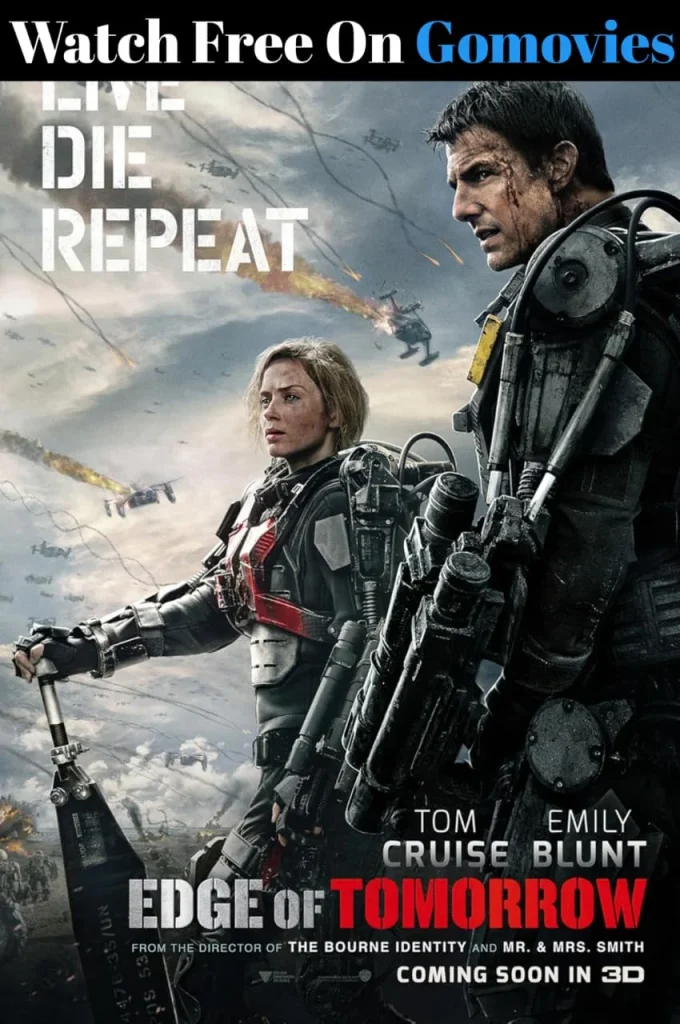
The clever time and consequence manipulation is what makes Edge of Tomorrow so distinctive. It makes the repetition something new and with every reset, it develops its characters and intensifies the game. The movie is a mixture of exciting action and fight scenes, as well as a dose of humor and self-examination, which provide viewers with both excitement and emotion. Its smooth integration of complexity in the narrative and entertainment made it gain critical acceptance and cult audience. It is still among the most re-watchable sci-fi movies of the decade, even several years after its release.
| Aspect | Details |
|---|---|
| Title | Edge of Tomorrow |
| Director | Doug Liman |
| Producer | Erwin Stoff, Tom Lassally, Jeffrey Silver, Gregory Jacobs, Jason Hoffs |
| Production House | Village Roadshow Pictures, Warner Bros. Pictures |
| Based On | All You Need Is Kill by Hiroshi Sakurazaka |
| Starring | Tom Cruise, Emily Blunt, Bill Paxton, Brendan Gleeson |
| Cinematographer | Dion Beebe |
| Music Director | Christophe Beck |
| Editor | James Herbert |
| Genre | Science Fiction, Action, War |
| Release Date | June 6, 2014 |
| Runtime | 113 minutes |
| Language | English |
Plot
The novel starts with a background of an almost future Earth where an alien race called the Mimics invaded the Earth. Major William Cage (Tom Cruise), a PR officer who has never been to war, is abruptly thrust into a battle after going against orders. On the first day of his war, he gets killed in a few minutes, yet he somehow finds himself back 24 hours before that, in a time loop. Each time he kills, he gets to repeat the same day and learns more and becomes a skilled murderer with each reset. Cage is assisted by war hero Rita Vrataski (Emily Blunt) to learn how to utilize this power and reverse the tide of war.
Cage is transformed into a brave strategist as the loops go on, making him a scared soldier. The so-called Angel of Verdun, Rita, turns into his guide and his support in a nightmare that repeats itself in a loop over and over again. The two discover the mystery of how the Mimics can manipulate time and they understand that the power of their opponent is its ability to rewind. Their quest is turned into a quest of precision, sacrifice and they seek the Omega, the alien hive mind and destroy it before even time itself can run out. The climax has a dramatic ending where death is not loss, but fate accomplished.
Performance
Tom Cruise gives one of the most complex roles of his lifetime. He begins as a timid officer who is trying his best to avoid fighting but becomes a tough soldier who can overcome his destiny. The combination of humor, fear, and resolve by Cruise is balanced, rendering the journey of Cage so real and emotional. The fact that he is ready to reveal his weakness makes this role distinct compared to his action-hero character. The film finds its emotional corner with the viewer as he develops through trial and error.
As Rita Vrataski, Emily Blunt is phenomenal. There is strength, smartness, and silent tragedy in her performance as a soldier who is characterized by loss but is purposeful. The way Blunt played a fierce and a human woman simultaneously won her unanimous acclaim and a new generation of adherents of the action films genre. Cruise and Blunt have an electric chemistry based on respect and mutual determination as opposed to romance. The futuristic chaos of the film is supported by Bill Paxton and Brendan Gleeson as they provide some sense of humor and power by basing it on human reality.
Direction and Screenplay
Director Doug Liman is surgical and creative in executing Edge of Tomorrow. Respected due to his The Bourne Identity and Mr. and Mrs. Smith, Liman is a good blend of kinetic action and emotional intelligence. All the loops are fresh because of the creative direction and clever editing, and repetition is not tiresome but rather interesting. The fact that he balances scale and intimacy makes the movie an epic and a character study. Liman transforms a high-concept idea into a deeply human narrative of bravery, persistence and self-realization.
Adapted by Christopher McQuarrie, Jez Butterworth and John-Henry Butterworth, the screenplay is lean, clever and oddly humorous. It combines complicated time-loop reasoning and bases it on emotive realism. Every repetition has a purpose – it unveils a new side of character or strategy – and the pacing is both quick and intentional. The conversation is crisp, particularly the jibe between Cage and Rita, which is full of tension and black humor. The structure of the script makes the audience never bored of the repetition of the scripts of the days.
Music
The score by Christophe Beck adds tension to the intensity of the film with orchestral tension and electronic rhythm. The music itself resembles the beat of a soldier getting ready to battle, and it provides urgency to each loop. The subtle motifs are developed as the character of Cage changes, becoming less cowardly and becoming more of a hero. The score is not melodramatic but rather about the mood and movement. The restraint by Beck makes the music complementary and not dominating the action.
The ambient sound design and silence that are used in the film are as effective. The sound effects of explosions, fire, and whirling exosuits provide the viewer with the feeling of futuristic warfare. The sound cues repetition is similar to the time loop, which generates familiarity and dread. The audio experience together with the themes by Beck creates a psychological loop in itself. It is not background music, it is an echo of survival.
Theme
Fundamentally, Edge of Tomorrow deals with the themes of resilience, redemption, and human adaptive capabilities. It asks the question: would you be able to be your best version of yourself, were you able to repeat your errors? Every death is a lesson, every repetition a metaphor of perseverance and development. The development of Cage is the journey of the soldier, the supreme soldier, who has mastered not only the art of fighting, but himself. By repetition he becomes familiar with the fact that it is not might that wins, but time and consequence.
The meaninglessness and repetition of the war is also explored in the film. However Cage sets it again and again, the human price is the same. The time loop turns into an image of the constant fight of man against destruction and his nature. This theme is made emotionally heavy by a tragic history of Rita, who once also bore the burden of time and loss. Their journey is a parable together on living with mortality and purpose in repetition.
Cinematography and Visuals
The cinematography of Dion Beebe brings to view the ugly beauty of the future war. The dullness of color used in the film, gray, metallic and war ravaged, is indicative of a world without hope but full of will. The camera work is more realistic with the chaos being filmed with the handheld camera and large-scale aerial shots depicting the magnitude of the final resistance of humankind. All the battle scenes are choreographed and the CGI and practical effects are perfectly integrated. The exosuits, explosions and alien creatures are realistic and frightening.
The visual effects team provides some of the most exciting action set pieces of the 2010s. The beach invasion sequence, which is of Normandy style, is reiterated several times, and each time it is stronger. The construction of the Mimics is fast, unpredictable, and almost fluid, which creates another level of fear of alien warfare. The editing of the film makes each loop of the film unique and even in repetition, the tension is present. It is visual storytelling at its most acute – chaotic and controlled.
Conclusion
Edge of Tomorrow is one of the most creative and smart sci-fi movies of the 21st century. It takes a high-concept notion and turns it into a story of human bravery, defeat, and change. Tom Cruise and Emily Blunt are playing powerhouse roles that are in perfect sync with the bold direction of Doug Liman. The combination of time, war tactics, and development of the characters in the film is perfectly well-timed, which makes it impossible to watch only once. Not many films strike this balance between heart, humor and spectacle as well.
Its impact is still felt in contemporary sci-fi narration a decade after release. Edge of Tomorrow demonstrates that heroism can be taught even in the world where chaos and repetition reign – one death at a time. Its main motto, Live. Die. Repeat, has turned into more than a tagline, it is a movie philosophy. To those who want to watch a movie that will not only satisfy their senses but also their minds, Edge of Tomorrow is currently available on GoMovies, and it is ready to run the loop one more time.