
Oblivion
Oblivion is a sci-fi adventure on gomovies that is visually beautiful and which combines the feelings of a man with the secrets of a post-apocalyptic planet. Directed by Joseph Kosinski, the film is a masterpiece of 2013, where Tom Cruise plays one of the most introspective and emotionally colored roles. The vast scenery, haunting music and philosophical overtones all make the film an intimate and majestic experience. It discusses the theme of identity, memory and purpose in a deserted world. Oblivion is a rare combination of spectacle and soul with its careful design and emotional narration.
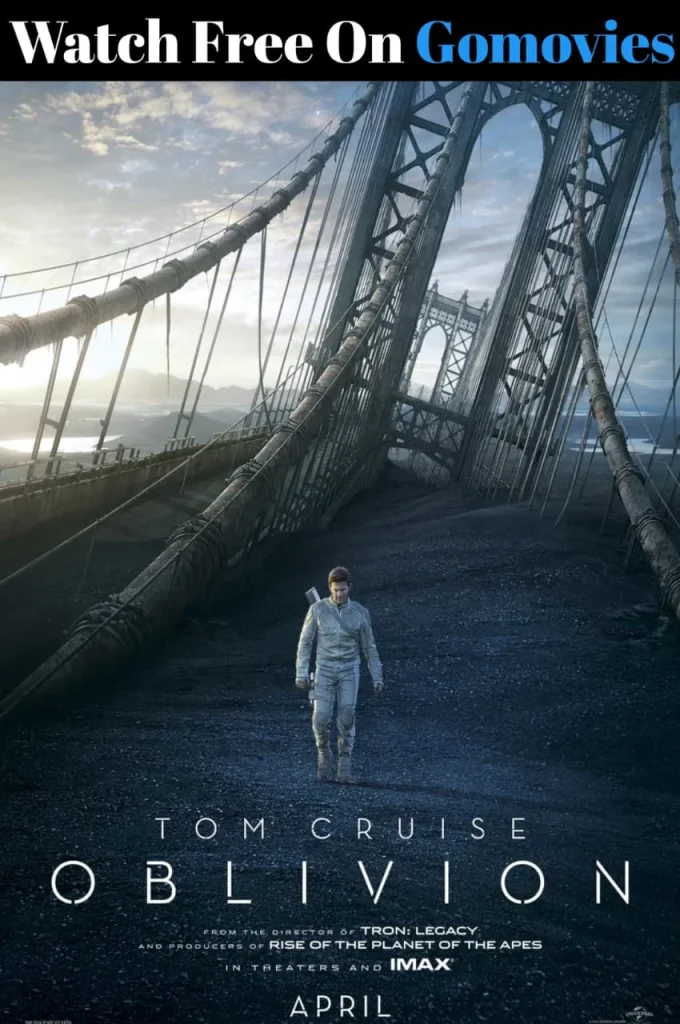
The story is set in the year 2077 and it describes the survivors of humanity in the aftermath of the alien war that has destroyed the planet. The earth is in the dust and its surface is deserted, with its oceans exhausted as sources of energy. Equipping the audience with issues of truth and existence, Oblivion engulfs the viewers as a story of rediscovery and rebellion. It is a movie that is technically flawless and emotionally serious. In its images, as well as its story.
| Aspect | Details |
|---|---|
| Title | Oblivion |
| Director | Joseph Kosinski |
| Producer | Peter Chernin, Dylan Clark, Joseph Kosinski, Barry Levine |
| Production House | Chernin Entertainment, Radical Studios, Universal Pictures |
| Based On | Original graphic novel by Joseph Kosinski |
| Starring | Tom Cruise, Olga Kurylenko, Andrea Riseborough, Morgan Freeman, Nikolaj Coster-Waldau |
| Cinematographer | Claudio Miranda |
| Music Director | M83 (Anthony Gonzalez), Joseph Trapanese |
| Editor | Richard Francis-Bruce |
| Genre | Science Fiction, Action, Drama |
| Release Date | April 19, 2013 |
| Runtime | 124 minutes |
| Language | English |
Plot
It is about a technician named Jack Harper (Tom Cruise) who is tasked with the duty of servicing drones that harvest energy in the sea of the earth. Jack is living in a glass tower above the clouds in a life that is regulated and monotonous with his communications officer Victoria (Andrea Riseborough). He is of the view that mankind has settled in Titan which is a moon of Saturn after the alien war had annihilated the planet. Nevertheless, weird dreams and findings start to break the reality of his mission. His perception of reality starts to break when he saves a mysterious woman Julia (Olga Kurylenko) who is on a crashed spacecraft.
In his quest to find answers, Jack meets Malcolm Beech (Morgan Freeman) a leader of human survivors who are underground. Beech discloses that the alleged aliens are nonexistent: and that the Tet, an orbiting space station, is an artificial intelligence that enslaves the Earth. Jack realizes to be a clone that was built by the Tet to sustain its operations. Being a human and a programmer at the same time, he chooses to engage in a battle to liberate the planet. The narrative reaches its peak and climax of a mighty ending that unites sacrifice, redemption and the victory of human will.
Performance
Tom Cruise gives us an acting masterpiece on emotional control and perseverance. He plays Jack Harper, a character who is conflicted by duty and self-awareness, which makes the character sympathize and be more than a one-dimensional character. The acting of Cruise is very introspective and it shows a hero who doubts not only his mission, but also his very existence. His relationships with Olga Kurylenko and Andrea Riseborough make the love triangle of the film more complicated. The outcome is a more human and philosophical sci-fi performance by Cruise.
Olga Kurylenko is a quiet, yet strong and vulnerable Julia, who is the personification of love, memory, and hope. Her appearance is what makes the story an emotional one the one that made Jack open his eyes. Andrea Riseborough, as Victoria, performs a subtle but chilling role- a woman who is faithful to her role but tormented by uncertainty. In his authoritative manner, Morgan Freeman grants seriousness to the cause of the rebellion in a wise, yet rebellious performance. The emotional and mysterious balance of the ensemble makes Oblivion more than just a run of the mill action movie, a profoundly human science fiction one.
Direction and Screenplay
Joseph Kosinski who is also a director of TRON: Legacy makes Oblivion with precision and vision. His direction focuses on size and loneliness and his emphasis on silence and enormity does as much to narrate as dialogue. The shots are painterly, each shot brings the beauty of the devastated Earth with a poetic immobility. The world of Kosinski is carefully planned, including the towers of sterile sky to the rotting cities on the ground. His managing of mystery and revelation is a tension-creating affair of a master story-teller.
Karl Gajdusek and Michael Arndt created a screenplay that is both minimalistic and emotional. It presents eternal sci-fi concepts, identity, cloning, and rebellion, through the prism of personal discovery. The dialogue is intelligent, and there is no exposition but rather emotional and visual narration. Every revelation puts more pressure on the inner struggle of Jack, which keeps the viewer guessing to the very end. The text is a perfect complement to the visual style of Kosinski that guarantees that the film is intelligent as well as beautiful.
Music
The music of the movie, performed by M83 together with Joseph Trapanese, is remarkable. The combination of the atmosphere of the electronic and the orchestral strength characterizes the mood of each scene. The title song, Oblivion, creates the impression of loneliness, beauty, and transcendence, as it relates to the process that Jack undergoes between ignorance and enlightenment. The music is soaring above the already breathtaking visuals of the film and redefining silence and movement into pure emotion. It is a soundtrack that remains a long time after the last credits have been shown.
Every musical indication reflects the emotional temperature of the scene in an ideal way. The action sequences are beatboxed with synth, whereas the scenes of self-reflectiveness are seen to breathe with aetheric sounds. The sound, however, goes hand in hand with the duality of the story, technology vs. humanity, emptiness vs. purpose. The cinematography of Claudio Miranda combined with the score makes the experience unique in its own way. The music, in most aspects, turns out to be the mouthpiece of the soul of the film, mumbling the poetry of solitude and optimism.
Theme
In the truest sense of the word, Oblivion is a philosophical reflection on memory, identity and what it means to be a human being. The story of Jack Harper resembles the one of human beings in the constant search of truth in the midst of deceit. His awakening makes the film ask the question that memories make us what we are- or are they just a resonance of who we were supposed to be. The fact that he is a clone does not make him a lesser human being; on the contrary, it enhances it. The film Oblivion is a reminder to us that consciousness and compassion are not dependent on biology or programming.
The movie is also an allegory of emancipation and defiance. The sky tower has the sterile perfection of the tower which symbolizes control, and the ruins of the earth symbolize authenticity and struggle. In rebellion against his creators, Jack reinstates his right to life and death to be on his own terms. The theme of the rebirth, both physical and spiritual, is repeated and connects the story. Finally, Oblivion glorifies love, sacrifice, and the spirit of the human being despite the destruction.
Cinematography and Visuals
The cinematography of Oblivion turns it into a visual poem created by Claudio Miranda. The Earth is captured with the use of natural light and wide-angle compositions as a wasteland and a work of art. The glass-walled floating sky tower is peaceful and a representation of human disconnection with reality. Conversely, the ruins at the ground level are very active with texture and history and reflect the forgotten truths. Each of the shots seems to be perfectly designed, combining the elements of futurism and the sadness of the fallen civilization.
The visual effects and the production design of the film make the balance between reality and imagination quite a rare item. The drones, bubbleship, and crumbling monuments are all tactile and lived in and the Oscar-winning light work of Miranda puts the minimalistic color palette of icy blues, pale whites, and rusted grays to the fore. The visuals combined with the direction of Kosinski bring about a feeling of isolation and wonder at the same time. Oblivion is not merely viewed, but felt, frame by frame, a philosophic reflection on beauty and decadence.
Conclusion
Oblivion is among the most beautiful and philosophical sci-fi movies of the 2010s. It combines smooth style and emotional narration, demonstrating that science fiction can be intellectual and emotional. Tom Cruise provides the character with humanity to the majesty of the genre, and Joseph Kosinski demonstrates visual control and emotional restraint. The two of them produce a movie that goes beyond its own storyline and turns into a commentary on the human timeless need to find meaning. Each circle, picture, and quietness in Oblivion has a deeper truth on memory and love.
Oblivion is a standard of atmospheric narrative and visual creativity, even years later. It is a movie that can be watched with amazement and thought provoking each time one watches it. Its motifs of identity and redemption are very strong in the modern technologically complicated world. To all the sci-fi lovers who want to experience the movie with emotion and beauty, Oblivion is now available on GoMovies- a movie reminder that even in the empty space the heart of human beings lives.